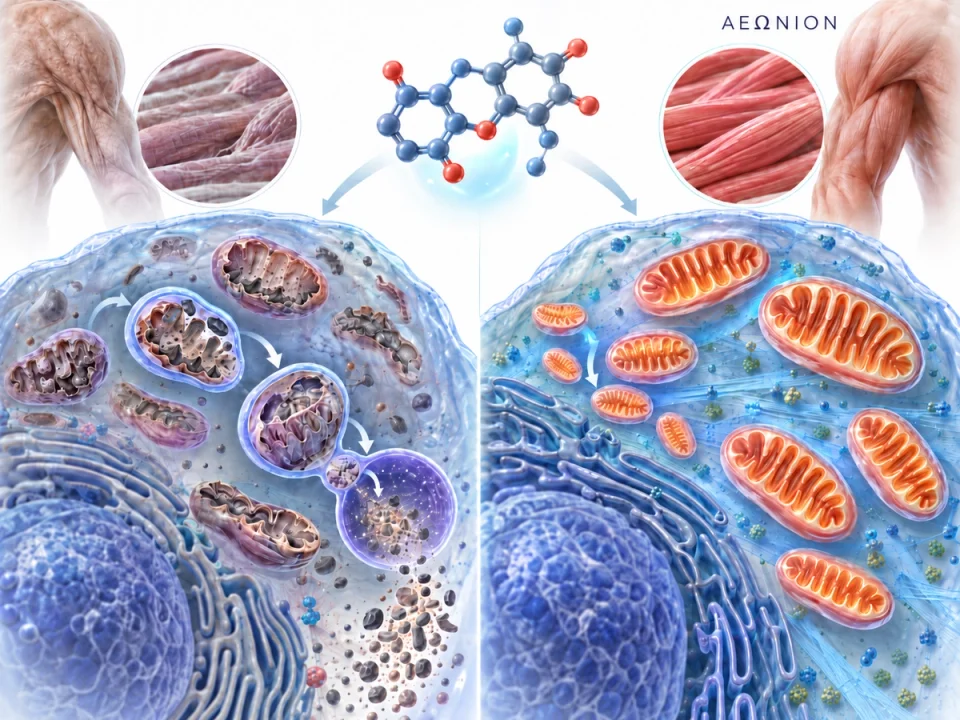
Urolithin A has attracted attention as a possible healthy-aging compound because of its effects on mitochondria, the structures cells use to generate energy. Human studies have now reported changes in muscle function, mitochondrial biology and, more recently, immune cells associated with aging. Together, the findings suggest that urolithin A can influence several biological processes that change with age, although whether those effects translate into slower aging or longer life remains unknown.
Despite its association with pomegranates, urolithin A is not found in large amounts in the fruit itself. Instead, certain gut bacteria produce it after breaking down ellagitannins and related compounds found in pomegranates, walnuts and some berries. One of its best-studied effects is the stimulation of mitophagy, a cellular quality-control process that helps remove damaged mitochondria.
Mitochondria gradually become less efficient with age, while the cellular systems responsible for removing damaged ones can also decline. Because mitochondria provide energy and regulate many other aspects of cell function, researchers have been investigating whether restoring mitochondrial quality control could help preserve tissue function during aging.
A 2024 systematic review in Ageing Research Reviews examined the available human evidence. It identified five studies involving a total of 250 healthy participants who received between 10 and 1,000 milligrams of urolithin A per day for periods ranging from 28 days to four months.
Across those studies, supplementation was associated with changes in several processes linked to aging. Researchers reported reductions in some inflammatory markers, increased expression of certain mitochondrial genes and markers related to autophagy and fatty-acid metabolism. Some studies also found improvements in muscle strength and endurance.
But the effects were not universal. The review found no consistent improvement in maximal mitochondrial ATP production, mitochondrial biogenesis or dynamics, gut microbiome composition, body measurements, cardiovascular outcomes or broader measures of physical function. The authors concluded that longer studies across more physiological systems would be needed before urolithin A could be considered a human geroprotective intervention.
A newer randomized trial, published in Nature Aging in 2025, investigated a different aspect of aging: the gradual decline of the immune system.
Researchers recruited 50 healthy adults aged 45 to 70 and randomly assigned them to receive either 1,000 milligrams of urolithin A or a placebo each day for four weeks. The study was double-blinded, meaning neither the participants nor investigators knew who was receiving the active treatment during the trial.
One of the main targets was the CD8 T-cell population. These immune cells help eliminate infected and abnormal cells, but their composition changes with age. The immune system gradually loses some of its naive T cells, which retain the ability to respond to unfamiliar threats, while more highly differentiated and exhausted populations accumulate.
After 28 days, participants receiving urolithin A showed an increase in a population of naive-like, less terminally exhausted CD8 T cells compared with placebo. The treatment difference was about 0.5 percentage points. The researchers did not find evidence of a broad increase in the total number of circulating T cells; instead, the composition of the CD8 population had shifted.
The researchers also found a larger change in how those immune cells produced energy. CD8 T cells from participants receiving urolithin A showed a greater capacity to use fatty acids for energy, with a treatment difference of about 14.7 percentage points compared with placebo. The cells also showed evidence of increased mitochondrial biogenesis, suggesting that their energy-producing machinery had been remodeled during the intervention.
Changes were detected in other parts of the immune system as well. Urolithin A increased certain natural killer cell and nonclassical monocyte populations. In laboratory assays, monocytes collected from treated participants showed increased bacterial uptake, while stimulated T cells produced more TNF, an inflammatory signaling molecule involved in immune activation. Exploratory single-cell sequencing also identified changes in metabolic and inflammatory pathways across several immune-cell populations.
The findings are consistent with the idea that targeting mitochondrial quality control can influence aspects of immune aging, sometimes called immunosenescence. But they do not show that the participants had biologically become younger.
The trial lasted only four weeks and did not test whether supplementation reduced infections, improved vaccine responses, prevented cancer, delayed age-related disease or increased lifespan. Changes in immune-cell populations and metabolism are biological measurements, not evidence by themselves that aging has been slowed.
The same distinction applies to the broader human evidence. The systematic review found encouraging changes in mitochondrial, inflammatory and muscle-related measures, but the studies were small and short compared with the decades over which human aging occurs. None demonstrated that urolithin A extends human life or delays the onset of age-related diseases.
Limits of the evidence
The Nature Aging trial involved only 50 healthy middle-aged adults and lasted 28 days. Its results therefore cannot establish whether the observed immune changes persist with long-term use or occur in older adults whose immune systems have undergone more pronounced age-related decline.
The broader evidence base is also still relatively small. The 2024 systematic review found only five eligible human studies involving 250 participants, with the longest interventions lasting four months. Although several biomarkers and measures of muscle performance changed, many other physiological outcomes did not.
There is also an important commercial connection. The 2025 trial was funded by Amazentis, the company behind the urolithin A product Mitopure, which also supplied the compound used in the study. Three authors were company employees, another was the company's president and board delegate, and one senior researcher reported consulting fees from Amazentis.
For now, urolithin A has a growing human research record showing that it can influence mitochondrial biology, muscle performance and some immune features associated with aging. What remains unanswered is the more important longevity question: whether changing these biological processes eventually translates into preserved health, fewer age-related diseases or a longer healthy life.
Limits of the evidence
The 2025 trial enrolled 50 healthy adults aged 45 to 70 and lasted 28 days, so it cannot show whether the immune changes persist with longer use or occur in older adults. It did not test infections, vaccine responses, age-related disease or lifespan. The 2024 systematic review found only five human studies totalling 250 participants, the longest lasting four months; many physiological outcomes did not change. Shifts in immune-cell populations and metabolism are biological measurements, not evidence that aging has been slowed.
Sources
- Effect of the mitophagy inducer urolithin A on age-related immune decline: a randomized, placebo-controlled trial
Denk et al. · Nature Aging 5:2309–2322 · First online October 31, 2025 · Randomised, double-blind, placebo-controlled trial in 50 adults aged 45–70.
- Targeting aging with urolithin A in humans: A systematic review
Hodzic Kuerec et al. · Ageing Research Reviews 100:102406 · 2024 · Five human studies, 250 participants, 10–1,000 mg/day for 28 days to four months.
Disclosure
The 2025 clinical trial was funded by Amazentis SA, which also supplied the urolithin A formulation (Mitopure) used in the study. Three authors are company employees and one is president and delegate of the board; one senior researcher reported consulting fees from Amazentis and the first author reported travel compensation from Amazentis and AbbVie.

Discussion
Have a question about the research or a perspective to share?
Loading discussion…