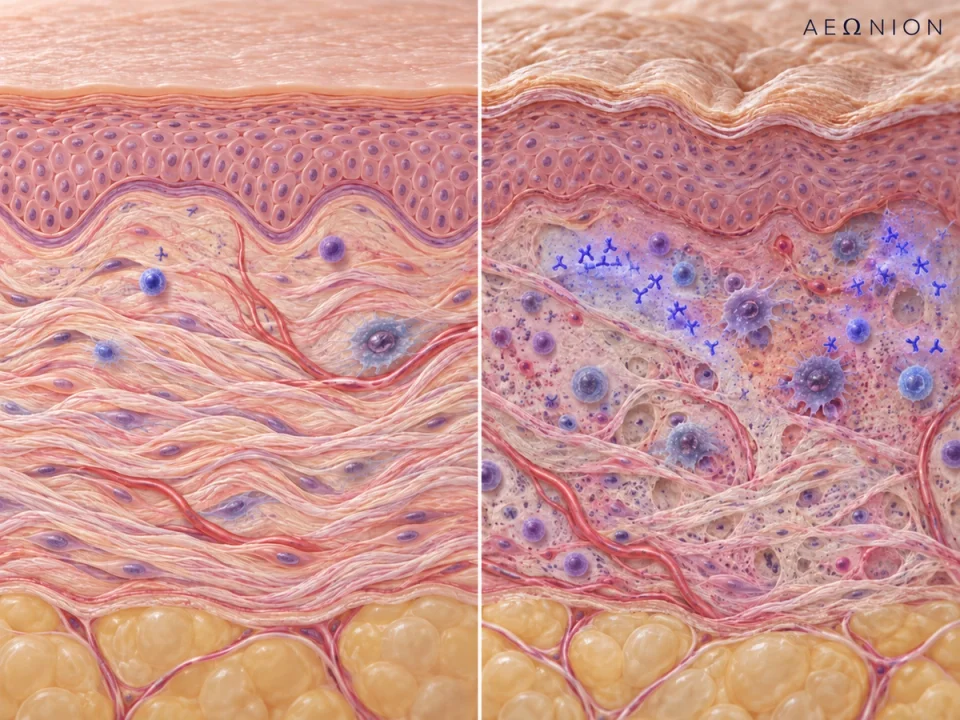
An antibody best known for its role in immune defence may also contribute to inflammation in aging skin. Researchers found that immunoglobulin G, or IgG, accumulated in older skin and triggered inflammatory changes when given to young mice. The findings suggest a possible contributor to skin aging, rather than a treatment that has been shown to reverse it.
The study, led by researchers at Kumamoto University in Japan, appeared online in the Journal of Investigative Dermatology on September 9. It combined experiments in male mice and laboratory-grown mouse cells with an examination of skin biopsies from seven people aged 13 to 85.
In mice, IgG built up in the dermis, the layer beneath the skin’s surface that contains collagen-producing cells called fibroblasts. Collagen helps give skin its structure. Older animals also had less densely packed collagen fibres and lower activity in genes involved in making collagen.
The human samples showed a similar age-related pattern: IgG staining was more prominent in the five donors aged 44 and older than in the two teenagers. But this was a small comparison of samples from different body sites, taken from people with skin cancer or epidermal cysts. It cannot establish that IgG causes skin aging in otherwise healthy people.
To test whether the antibody could provoke inflammation, the team gave young mice weekly IgG injections for four weeks and compared them with mice receiving a control solution. More IgG reached the skin, alongside an increase in immune cells called macrophages and T cells. The immune-cell counts involved four mice per group; some gene-expression measurements involved ten per group.
Cell experiments helped explain how these changes might connect. IgG increased activity in genes for signals that attract immune cells. Fluid collected from treated macrophages attracted more cells in a laboratory test.
The macrophages also released more interleukin-12, a messenger that encouraged T cells to produce interferon-gamma, another immune signal. Blocking interleukin-12 reduced that response in the laboratory.
When the researchers separately exposed mouse skin fibroblasts to interferon-gamma, activity in two collagen-producing genes fell. Together, the results suggest a route by which accumulating antibodies could promote inflammation and interfere with collagen production.
That chain of events still needs to be tested directly in living, naturally aged animals. Injecting extra IgG into young mice does not fully reproduce its gradual accumulation with age, and the study did not show that removing it restores collagen or reduces wrinkles.
The work identifies a potential target for further research. Whether changing this immune pathway can safely preserve aging skin remains an open question.
Limits of the evidence
Male mouse and cell experiments, alongside observational skin biopsies from seven people with skin cancer or epidermal cysts. The complete pathway has not been causally demonstrated in living aged skin. No treatment to reverse skin aging, restore collagen or reduce wrinkles was tested.
Sources
- Aging-related IgG accumulation promotes skin inflammation
Suzuki et al. · Journal of Investigative Dermatology · First online September 9, 2026 · Mouse/cell experiments and seven human skin biopsies.
Disclosure
The study received support from Japan’s Agency for Medical Research and Development and the Center for Metabolic Regulation of Healthy Aging. Senior author Yuichi Oike disclosed research funding from Saishunkan Pharmaceutical; the paper states that the company had no role in the study’s design, analysis or writing.

Discussion
Have a question about the research or a perspective to share?
Loading discussion…