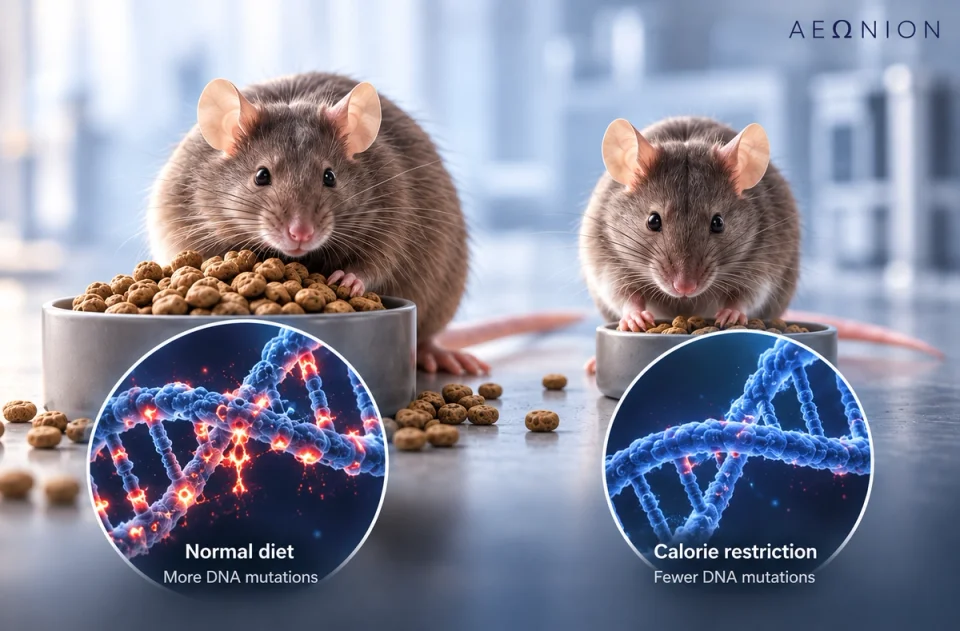
Every cell in the body gradually accumulates mutations in its DNA as it ages. Most of these changes are harmless, but some can disrupt genes, contribute to cancer or alter how tissues function. The progressive loss of genomic stability is considered one of the biological hallmarks of aging.
Researchers have now found that this accumulation is not necessarily fixed. In a study published in Cell, mice kept on long-term calorie restriction carried fewer age-related mutations across several tissues than mice allowed to eat freely, suggesting that diet can influence how quickly permanent changes build up in the genome.
The study focused on caloric restriction, an intervention in which animals consume fewer calories while still receiving adequate nutrition. Caloric restriction has extended lifespan in organisms ranging from yeast and worms to rodents and monkeys, although exactly how it produces those effects remains unresolved.
The researchers analyzed 36 male C57BL/6J mice at 19 months of age. Twelve had been allowed to eat freely, while two groups of 12 received restricted diets beginning early in life. Both restricted groups initially consumed about 30% fewer calories, but their food was delivered on different schedules. One group received its food near the beginning of the animals' normal active period and ate it within roughly two hours, while the other received small portions spread across the full day.
Those feeding schedules came from an earlier lifespan experiment. In that study, calorie restriction spread across the day extended median lifespan by about 10%, while combining calorie restriction with a long daily fasting interval and feeding during the mice's normal nighttime active phase extended median lifespan by about 35%.
The new study asked a different question: did those diets also change the amount of DNA mutation that accumulated with age?
To measure mutations that would normally be difficult to detect, the researchers used a high-accuracy method called duplex DNA sequencing. Unlike inherited genetic variants, the mutations examined here were somatic mutations — DNA changes acquired by individual cells during life through processes such as DNA damage, replication errors and imperfect repair.
The team sequenced DNA from whole liver and kidney tissue as well as purified liver cells called hepatocytes and neurons from the cerebellum. Across all samples they detected more than 24,000 single-letter substitutions and around 6,400 insertions and deletions, in which DNA letters had been added or removed.
The differences between the diets were largest in the liver.
Compared with mice eating freely, calorie-restricted mice had approximately 29% fewer DNA substitutions in whole liver, 15% fewer in kidney and 39% fewer in purified hepatocytes. Cerebellar neurons also showed a lower substitution burden, but the difference was not statistically significant.
Calorie restriction also reduced some insertions and deletions. These mutations were about 34% lower in liver tissue and 26% lower in hepatocytes compared with mice eating freely.
The researchers then looked not only at how many mutations occurred, but at the patterns they formed.
Different biological processes leave characteristic patterns of mutations known as mutational signatures. One of the most common is SBS5, an age-associated signature found across many mammalian tissues whose underlying biological cause is still not fully understood.
In this study, an SBS5-like process accounted for roughly 85% to 94% of the substitution mutations detected across the different tissues. Calorie restriction reduced the number of mutations attributed to this process in liver, kidney, hepatocytes and cerebellar neurons.
An unexpected pattern appeared when the researchers examined where in the genome the mutations occurred.
The protective effect of calorie restriction was strongest in parts of the genome that were not actively being transcribed into RNA. In hepatocytes, for example, regions of inactive genes contained around 2.5 times as many substitutions in unrestricted mice as in calorie-restricted mice. In the most highly expressed genes, however, there was essentially no detectable difference between the groups.
A similar pattern appeared when the genome was separated according to how accessible the DNA was: calorie restriction reduced mutations more clearly in relatively inaccessible regions than in open, active chromatin.
Why this happens is not yet known. One possibility raised by the researchers is that actively used regions of DNA already receive more intensive repair, leaving less room for calorie restriction to produce an additional benefit. Alternatively, calorie restriction may alter the amount or type of DNA damage occurring across the genome. The study does not establish which mechanism is responsible.
The results provide a new connection between metabolism and one of the molecular features of aging. Rather than somatic mutations accumulating entirely as an unavoidable consequence of time, their burden appears capable of being modified by a physiological intervention.
But an important result also argues against a simple explanation in which fewer mutations directly account for the longer lives of calorie-restricted mice.
The two restricted feeding schedules produced very different lifespan effects in the earlier experiment — roughly 10% versus 35% longer median lifespan — yet the new study found no significant difference between them in overall mutation burden.
That means reduced mutation accumulation may be one biological effect of calorie restriction, but the data do not show that it is the reason the animals lived longer. Other changes caused by calorie restriction, including effects on metabolism, inflammation, circadian biology and other aging pathways, are likely to contribute as well.
The findings also do not mean that eating 30% fewer calories has been shown to protect the human genome or extend human lifespan. This was a mouse experiment using substantial calorie restriction beginning early in life, and the researchers did not test whether similar reductions in somatic mutations occur in people.
Limits of the evidence
The study used only male mice of a single genetic background, so it is unclear whether the magnitude of the effect would be the same in females or other mouse strains. The animals also began calorie restriction at about three months of age, after a six-week period of unrestricted feeding used to set each animal's baseline intake, making the experiment different from someone beginning dietary restriction in middle or older age.
The effects were also tissue-dependent. Mutation reductions were particularly strong in liver cells, smaller in kidney tissue, and less clear in cerebellar neurons. The experiment therefore does not establish that calorie restriction suppresses mutation accumulation equally throughout the body.
Most importantly, the study establishes that calorie restriction changes somatic mutation burden, not that those mutations are responsible for aging or for calorie restriction's lifespan effects. The authors themselves note that whether the age-related accumulation of somatic mutations is a cause of aging or a biomarker that accompanies it remains unresolved.
The study nevertheless adds genomic integrity to the growing list of biological processes that can respond to interventions associated with longevity. The next question is whether researchers can identify the pathways responsible for the lower mutation burden — and whether those pathways can eventually be targeted without requiring lifelong, substantial calorie restriction.
Limits of the evidence
Male mice of a single strain only. Calorie restriction began at about three months of age, unlike dietary restriction started in middle or later life. Effects were tissue-dependent: strong in liver cells, smaller in kidney, and not statistically significant in cerebellar neurons. The two feeding schedules differed markedly in lifespan effect, roughly 10% versus 35%, yet showed no significant difference in mutation burden, so fewer mutations cannot be assumed to explain the longer lives. Whether somatic mutation accumulation causes aging or accompanies it remains unresolved. No human data.
Sources
- Caloric restriction modulates genome-wide somatic mutation in mice
Grońska-Pęski et al. · Cell · First online September 9, 2026 · Duplex sequencing of liver, kidney, hepatocytes and cerebellar neurons from 36 male C57BL/6J mice at 19 months.
- Circadian alignment of early onset caloric restriction promotes longevity in male C57BL/6J mice
Acosta-Rodríguez et al. · Science 376:1192–1202 · 2022 · The lifespan experiment that produced the feeding schedules used here.
Disclosure
Supported by the Pew Charitable Trusts, the Jacob Goldfield Foundation, the National Institutes of Health (National Institute on Aging grants T32AG052909 and F32AG076287, and NIH Common Fund grant UH3NS132024), the Damon Runyon Cancer Research Foundation, the Smythe Family Impact Fund, philanthropic funds from the Vail family, and the Howard Hughes Medical Institute. The authors declare no competing interests.


Discussion
Have a question about the research or a perspective to share?
Loading discussion…