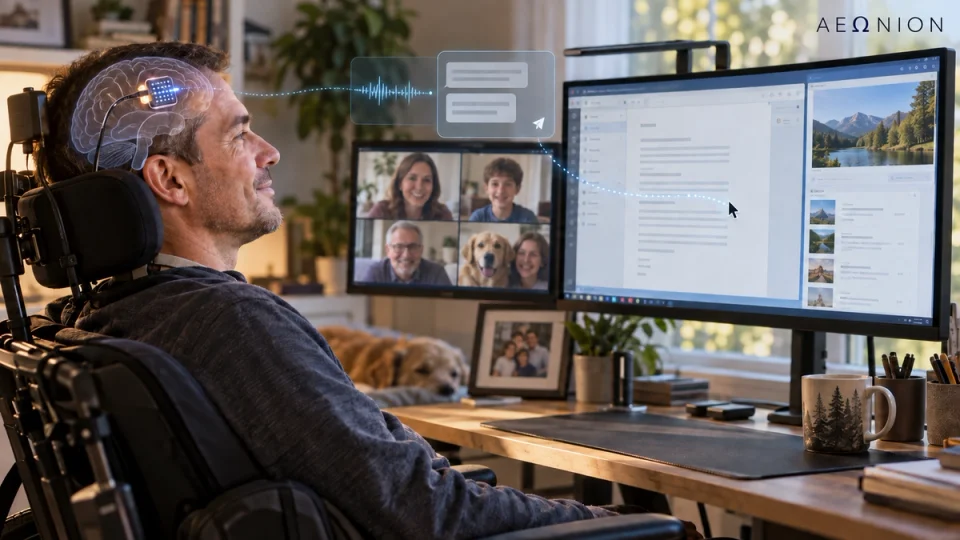
A man living with ALS has used a brain implant to communicate and operate his computer at home for more than 3,800 hours. The system helped him exchange messages, browse the internet and maintain full-time employment despite severe paralysis. The findings were published in Nature Medicine on June 15, 2026. Original study
The participant, Casey Harrell, has severe difficulty speaking because of ALS. Researchers at UC Davis developed a brain–computer interface that translates activity associated with attempted speech and movement into words and computer commands. UC Davis research report
Small electrodes implanted in a brain region involved in speech record signals as he tries to speak. AI software converts those patterns into text, which can then be read aloud by a digital voice designed to resemble his voice before ALS. A separate decoder lets him control a computer cursor. How the system works
Over the study period, Harrell communicated close to two million words, averaging 56 words per minute. He rated 92% of sentences as accurate or mostly correct. In controlled tests, where he attempted words shown on a screen, the system achieved over 99% word accuracy—a different measure from everyday conversation. Reported results
The advance is its usefulness in daily life. Harrell could communicate when he wanted, without researchers present to operate the equipment. That meant more opportunities to talk with friends and family and interact with the digital world on his own terms. UC Davis report
There are still practical limits. Trained caregivers helped connect the hardware and start the software. The system used wired connections and bulky equipment, restricting it to his home. This report involved one person, so further studies must establish how reliably it works for others. Study limitations
Sources
- Long-term independent use of an intracortical brain–computer interface for speech and cursor control
Card et al. · Nature Medicine · June 15, 2026 · Single-participant report from the BrainGate2 clinical trial
- Brain-computer interface enables independent, accurate communication for man living with ALS
UC Davis Health · June 15, 2026
Disclosure
Several researchers reported relevant patents, licensing arrangements or advisory relationships with neurotechnology companies, detailed in the paper’s competing-interest statement.

Discussion
Have a question about the research or a perspective to share?
Loading discussion…