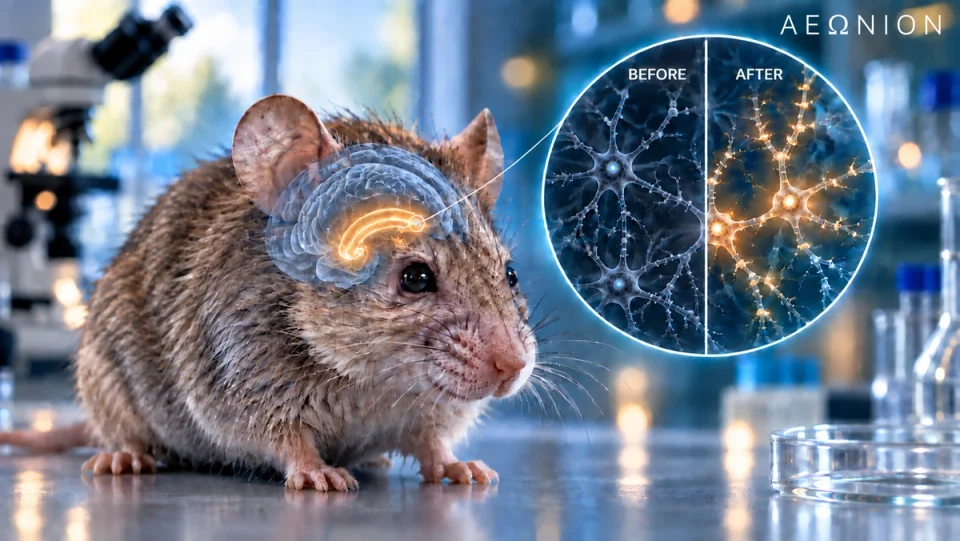
Scientists at EPFL in Switzerland have improved memory in older mice by targeting a small group of brain cells involved in learning. In several experiments, treated animals performed at levels comparable to young, healthy mice. The findings were published in Neuron on February 10, 2026. Original study
The approach focuses on cells called engram neurons. These are groups of neurons that become active when we learn something and can reactivate when we remember it. Aging and disease can disrupt their function, making memories harder to retrieve.
The researchers used precise brain injections to deliver a gene therapy that briefly switched on three genes, collectively called OSK, in neurons activated during learning. This process, known as partial reprogramming, aims to restore more youthful features while preserving the cells’ identity as neurons. EPFL’s explanation of the research
The team tested memory through tasks involving learned associations and navigation. In one experiment, older mice showed improved recall two days after learning. Targeting another brain region improved memory tested two weeks later.
Mice genetically engineered to develop features of Alzheimer’s disease also benefited. Depending on the brain region targeted, treatment improved how they learned to navigate a water maze or remembered the location they had learned. The experiments targeted cells during learning; they did not demonstrate the recovery of long-forgotten personal memories. Original study
Inside the treated neurons, researchers also observed changes toward healthier patterns of gene activity and electrical signalling. Together, these results suggest that helping specific memory-related cells function better could become a direction for future treatments. EPFL research report
However, this remains an animal experiment, not a treatment demonstrated in people. The Alzheimer’s models represented only some aspects of the disease, and the precise targeting required is far from ready for routine clinical use. Whether the approach can produce lasting benefits safely in humans remains unanswered. Study and limitations
Sources
- Cognitive rejuvenation through partial reprogramming of engram cells
Berdugo-Vega et al. · Neuron · Published online February 10, 2026 · Mouse experiments
- Rejuvenating neurons to restore memory in mice
EPFL research report · February 11, 2026 · French
Disclosure
The study authors declared no competing interests.



Discussion
Have a question about the research or a perspective to share?
Loading discussion…